Oaxaca · Cañada · Santa María Tlalixtac

Alambique Serrano

Three generations of Krassel-family rum, made on a sugarcane mountainside in Oaxaca.

Alambique Serrano
1917
Max Krassel arrives in Veracruz
3
Generations of Krassels
4
Brothers running it today
3,900ft
Cane elevation (max)

Why we carry them

Alambique Serrano is a small, family-run rum project in Santa María Tlalixtac, in Oaxaca's Cañada region — reached, per the importer, via "a four-hour unpaved trek from the nearest highway." The Krassel Peralta family plants, harvests, and distills 100% organic Java sugarcane on the steep slopes of the village (cane elevation roughly 2,300 to 3,900 feet above sea level), bottles at the producer's preferred strength with no added sugar, color, or flavoring, and labels each release with the cask or blend number. We carry them because the spirit overlaps perfectly with the rest of our cane-spirit shelf — it's the Oaxacan answer to the question The Rums of Mexico is asking from Veracruz and Jalisco.

Three generations of Krassels in Oaxaca

The family story is genuinely unusual for a Mexican rum.

Max Krassel, a German immigrant, arrived on the Veracruz Gulf coast in 1917 at age 16, fleeing World War I. He spoke no Spanish, took odd jobs, and eventually settled in Oaxaca's mountainous Cañada region where he married and raised a family. He distilled aguardiente on a coffee farm and then built his own still in the 1930s — the founding moment of what would become Alambique Serrano.

Max's three sons took over and refined the still design. One of them, Max Jr., earned a pilot's license in Tehuacán, Puebla and in the 1970s used a Cessna to deliver aguardiente — orders of up to 300 liters — to remote mountain communities with airstrips. (Yes, really.)

The current generation is four brothers — Isidoro, Rommel, William, and Axel Krassel Peralta — who run cultivation, fermentation, distillation, and aging together. The export-label distillery is registered as Distillería de Rommel Krassel, Santa María Tlalixtac, Oaxaca. The family describes the project as "100 years in the making."

The cane · high-altitude organic Java

The Java cane variety is grown almost exclusively at altitude in this part of Oaxaca. The thin air, cool nights, and aggressive slope make for a slower-growing, denser cane than what you'd find on a tropical lowland plantation — concentrated sugars, more aromatic complexity, and a palate that runs toward tropical fruit, lily, raspberry marzipan, and warm spice rather than toward molasses-driven Caribbean sweetness. Cane is hand-harvested from the steep laderas (hillsides) and transported to the mill by horse, donkey, or mule. The mill is a Campollo 9" trapiche moved seasonally by the family; it processes ~10 tons of cane per batch. Fresh juice is then gravity-fed through a hose system up to 2 km long from the press to the distillery — no pumps, no electricity. Most of the lineup is bottled at full cask strength without dilution; when cut, water comes from the Río Blanco that runs near the property.

The Krassel Still · Max's engineering legacy

The centerpiece of the operation is the Krassel Still — a continuous column still that Max Krassel himself designed and built in the 1930s. Eight plates, no head and no tail cuts (the column is calibrated so the run never produces them), with ABV regulated by the temperature of the cooling chamber and the rate of fresh juice flow. Per PM Spirits, the still is diesel-fired rather than wood-fired — a deliberate choice the Krassels made decades ago to avoid contributing to deforestation in the Cañada region. It's an unusual position to take for a Mexican distiller of this generation, and it tells you what kind of operation this is.

The Krassel Still produces the lighter, more agricole-leaning expressions in the lineup — the unaged Cartier 30, the column-still components of the blends, and the bulk of what the family bottles at column strength.

The pot-still path · Rommel's recent introduction

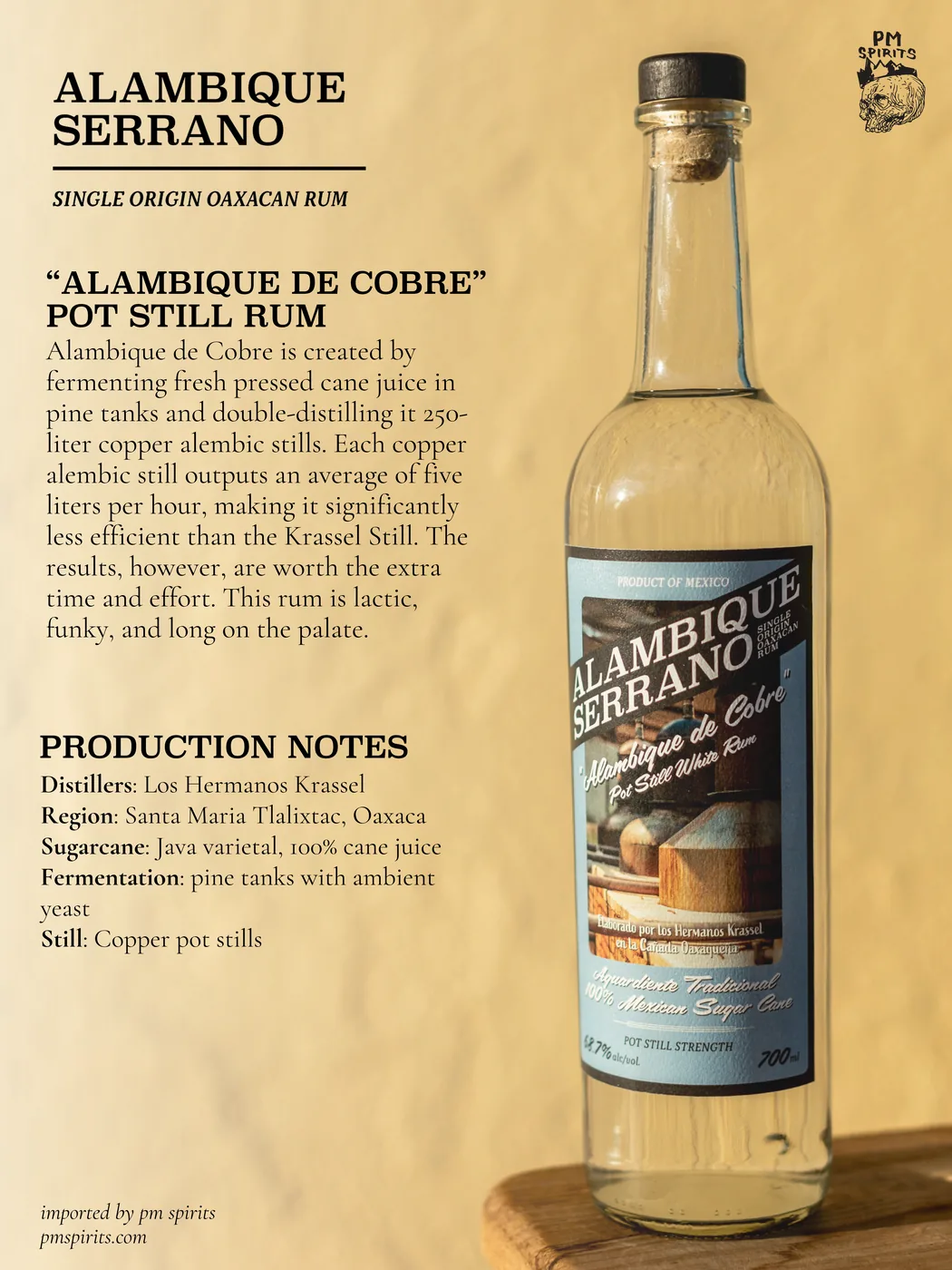
Rommel Krassel recently added rustic copper alembic pot stills to the operation — the same equipment used for centuries to make mezcal in the Oaxacan Valleys, just up the road. The pot-still rums are the heavier, higher-ester end of the lineup, including the Altos Esteres expressions whose ~25-day pine-vat ambient-yeast fermentation is roughly five times the length of standard Caribbean rum fermentation. The result, in PM Spirits' description: "higher proof, heavier rums that are intensely aromatic and pleasantly oily — unlike anything else in the category."

Two parallel production paths, then, run side by side at the same distillery:

  • Krassel column path — fermentation in seven 1,200-liter stainless-steel tanks stored outside the distillery, spontaneous wild-yeast ferment for 6–10 days, distilled on the column.
  • Pot-still path — fermentation in three pine vats in a small bodega, ambient yeasts, distilled in copper alembics. This is where the Altos Esteres comes from.

Aging happens across four bodegas at varying elevations and humidity: a dry one at ~5,600 ft, a humid one at ~2,000 ft, an ultra-humid site about 100 m from the Río Blanco, and a small cave at the foot of the river exposed to the elements. Same cane, same family, four different aging environments. Barrel types in rotation: ex-whisky, ex-cognac, new French oak, ex-sherry, ex-mezcal.

The bottlings

  • Cartier 30 · unaged, ~70% ABV. Named for the "30" mark on the historic Cartier hydrometer scale — the local preferred strength. Distilled on the Krassel column from naturally-fermented fresh cane juice; bottled at still strength with no sugar or water added. PM Spirits' tasting notes: "funky, grassy, briney, and punchy."
  • Altos Esteres (1st & 2nd Editions) · pot still, ~25-day ambient-yeast pine-vat ferment, ~63.9% ABV. The high-ester expression — funkier, more aromatic, a peer to good Jamaican pot-still rum but in a drier, more savory register.
  • 3 Años (1st Ed., 46.1% ABV) · a 12-cask blend of pot-still and Krassel-column rum aged a minimum three years in new French oak, brought to proof with Río Blanco distilled water; no added sugar or coloring. PM Spirits' tasting notes: "orange peel, cinnamon roll, apple juice, raisin cake, and black pepper on the nose" — palate "cinnamon butter, rolled oats, orange marmalade, red hots, and cooling menthol."
  • Single Casks · individual numbered barrels — Single Cask #14 (2 years ex-bourbon), #20 (French oak), #25 "Horus Cooper's Tenacity," #32, plus the 2025 series #144 (new French oak, 286 bottles), #268 (ex-bourbon), #296 (new Hungarian oak, 299 bottles). When the cask is gone, it's gone.
  • Blends · #1, #2, #3 "Matadiablos," #4 "Tres Maderas," #5 "El Boxeador," #6 "Otoño," #10 "El Estado Dorado" (June 2025; 907 bottles), Vida Nativa.

Bottle specs and tasting notes sourced from PM Spirits and the producer's own pages.

Press · what other people are saying

The importer · PM Spirits · sister-brand to 5 Sentidos

Alambique Serrano is imported into the United States by PM Spirits in Brooklyn, the same importer that brings in 5 Sentidos. Founded by Nicolas Palazzi, PM Spirits built its national portfolio by working only with small, transparent, producer-led brands — many of which we carry at Off Premise. The Krassel family also operates two sister projects: Cañada (a separate cane-spirit label) and a small distribution role with 5 Sentidos itself.

A sister project to The Rums of Mexico

Alambique Serrano sits naturally alongside The Rums of Mexico on our shelf. Both are small-batch, transparently-labeled cane spirits from Mexico. The Rums of Mexico project covers Veracruz, Jalisco, and a corner of Oaxaca; Alambique Serrano is the Oaxacan high-altitude voice in the same conversation. If you've worked through one and want more, this is where we send you next.

In stock at Off Premise

4 bottles · click to add to cart

Alambique Serrano Altos Esteres

Alambique Serrano Altos Esteres

Alambique Serrano Altos Esteres is an unaged, cask-strength rum made from high-altitude Java sugarcane grown on the steep slopes of Santa Maria Tlalixtac in Oaxaca. This second-edition release ferment…

$95
Alambique Serrano Single Cask #32

Alambique Serrano Single Cask #32

Alambique Serrano Single Cask #32 is an Oaxacan rum distilled from Java varietal cane sugar grown between 2,500 and 3,800 feet above sea level in Santa Maria Tlalixtac. Rommel Krassel distilled this s…

$90
Alambique Serrano 2nd Edition 3 Anos Ex Bourbon and New French Oak Oaxacan Rum

Alambique Serrano 2nd Edition 3 Anos Ex Bourbon and New French Oak Oaxacan Rum

Nose: aloe vera, watermelon agua fresca, madonna lily, stewed plantains, raspberry marzipan, cinnamon candy, orange oil. Palate: a burst of tropical fruits along with lime zest, watermelon, and cucumb…

$65
Alambique Serrano Cartier 30 (142.8 Proof)

Alambique Serrano Cartier 30 (142.8 Proof)

Cartier 30 is an unaged rum produced in the town of Santa Maria Tlalixtac, Oaxaca. Along the steep slopes of this region, the Krassel family plants, harvests, and distills 100% organic java sugarcane…

$70